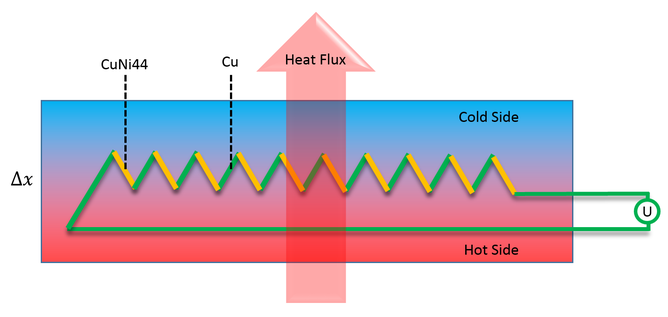
Flux-Strip: Measuring heat-flux with Thermopiles
- Our sensors measure the heat flux through a surface by detecting a very small temperature difference across a thin, well‑defined thermal resistance.
- Inside a typical sensor, many hundreds or thousands of thermocouples are connected in series (a thermopile).
- With FluxStrip, we place dense thermopiles on a flexible strip, giving you a neat, highly adaptable platform for custom heat flux sensor geometries.
- The temperature difference is converted into a millivolt‑range thermoelectric voltage.
- This voltage is proportional to the local heat flux; using the individual calibration factor, it is directly converted into heat flux in W/m²
q: heat flux in W/m²
c: calibration factor in W/(m²·V)
U: sensor output voltage in V
- We use Type T thermocouple junctions, an industry‑standard choice known for their high sensitivity and reliability.
-
A low additional thermal resistance and a surrounding guard ring minimize disturbance of the original temperature field, so the measured heat flux closely matches the real system behavior.
-
The sensors are fully passive, have a low internal resistance, and can be read out easily and with low noise using standard measurement equipment.